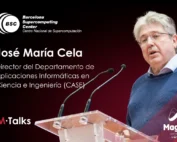
We visited the Barcelona Supercomputing Center (BSC), one of Europe’s leading high-performance computing hubs, for a new edition of M·Talks. On this occasion, our CEO Felipe Gracia speaks with José María Cela, director of the CASE department, about the role of computational simulation in modern science, the challenges of high-performance computing, and the future of supercomputing.
In an interview that spans from the AI revolution to the horizon of nuclear fusion, Cela offers a clear and unfiltered view of the current state of technology and the strategic challenges facing Europe.
The human factor in the age of artificial intelligence
The rise of generative AI has radically transformed technological development, enabling software creation with “10 times fewer resources and 10 times faster.” However, Cela warns against the complacency of delegating critical thinking to machines.
“AI needs Fernando Alonso at the wheel to truly make the most of it. An average person is not capable of extracting that ability.”
This metaphor highlights an unavoidable reality: AI is an extraordinarily powerful tool, but solving frontier problems requires highly trained specialists who know how to ask the right questions. He also warns about the risks of blind trust:
“What worries me is that people use AI and become careless. They ask for information and do not cross-check it at all… AI hallucinates and also has a bias toward pleasing the user; it always wants to agree with you.”
The challenge of European technological sovereignty
The conversation also addresses the global tech race, where Europe is in a delicate position compared to the United States and China. Cela is clear in his diagnosis:
“Those clearly leading this are the United States and China… Europe has not done it. Europe is behind. And if we don’t get close to the leading pack, we will be completely left behind.”
Initiatives such as the European Chips Act are steps in the right direction, although they require sacrifices. Regarding local microelectronics development, Cela notes that “there is a path we must follow in which there is no immediate profit,” acknowledging the strategic need for long-term investment to reduce dependence on Asia and North America.
Quantum computing and the future of energy
Faced with the enormous energy consumption of modern data centers, Cela reflects on energy as a pillar of civilization: “Electricity consumption will not stop increasing… Not having energy essentially means going backwards, to how people lived 100 years ago.”
According to Cela, the solution is not current nuclear fission, but fusion:
“The real solution is fusion. Fusion is reproducing in a room what happens in a star.”
He makes a bold prediction: “I am convinced that in less than 10 years there will be a reactor that produces more energy than it consumes.” Regarding quantum computing, often surrounded by excessive short-term optimism, Cela adds historical realism: “Current quantum computers are like the Wright brothers’ plane compared to modern aircraft… They solve no practical problem.”
Humanities and mathematics: the education of the future
To lead this paradigm shift, Cela emphasizes the need to strengthen mathematical foundations from primary education. But he also defends the essential role of the humanities:
“You need the humanities because we are not robots; people ultimately have to make decisions. And decisions not based on technology, but on humanism, on understanding society, human behavior, philosophy, and ethics.”
An essential conversation about the machines driving cutting-edge scientific research—and the minds that must guide them.
If you found it interesting, please share it!
Recent Articles