On July 17, 2026, the European Commission presented a key legislative proposal to revise the European Union Emissions Trading System (EU ETS). This revision, aligned with the objective of reducing net emissions by 90% by 2040, introduces significant adjustments designed to balance climate ambition with industrial competitiveness and the promotion of investment.
The proposed redesign seeks to mitigate the risk that decarbonisation might compromise European growth and competitiveness. In its baseline scenario, the Commission estimates approximately 330 billion euros in investment needs between 2031 and 2040 for five major energy-intensive industries; it further estimates around 80 billion euros for iron and steel.
Description and Proposed Changes
The proposal sets out a modernisation of the carbon market through several structural modifications:
- Adjustment of the cap trajectory: It is proposed to slow down the annual reduction of the emissions cap. From 2031, the annual reduction would shift to 3.7% (compared to the current 4.3%), and it would decrease further to 1.7% from 2036. This allows for a more gradual decline and the continued issuance of allowances into the 2040s.
- Creation of the Industrial Decarbonisation Bank (IDB): It is proposed to establish an EU-level entity with the goal of mobilising 100 billion euros. In a first phase (2028-2030), the “Investment Booster” would reserve 400 million allowances to provide fixed carbon premiums to decarbonisation projects, with a share reserved for lower-income Member States. From 2031, a second phase would primarily use competitive bidding and Carbon Contracts for Difference (CCfDs) or carbon premiums. The political objective of creating an Industrial Decarbonisation Bank (IDB) was not first conceived in July 2026. The European Commission had already announced its intention to propose it on February 26, 2025, as part of the Clean Industrial Deal. What the July 2026 proposal does is legally materialise that promise within the carbon market. Before this proposal, the EU already had the Innovation Fund, also financed through the EU ETS and focused on supporting pioneering, highly innovative, and higher-risk technologies. The new Bank does not replace the Innovation Fund, but rather complements it. While the Innovation Fund remains for the early stages of commercialisation, the IDB targets more mature decarbonisation technologies that need to scale and be deployed. To facilitate this deployment, the IDB introduces specific commercial de-risking tools: in its first phase (the “Investment Booster”), it will grant fixed carbon premiums linked to avoided emissions; from 2031, it will use competitive bidding to award Carbon Contracts for Difference (CCfDs) or carbon premiums, guaranteeing long-term stable revenues to industries investing in decarbonisation. The 100 billion represents a mobilisation target, not a single appropriation of readily available cash. The proposed architecture reserves 400 million ETS allowances for 2028-2030 and another 400 million for 2031-2040; their monetary value will depend on auction prices. The Commission positions this mechanism alongside Innovation Fund resources, additional ETS revenues, and the revision of InvestEU to attract complementary financing.
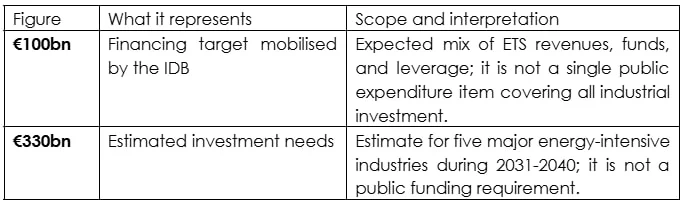
A purely arithmetic comparison places the 100 billion at around 30% of the 330 billion, leaving a nominal difference of 230 billion. However, this should not be interpreted as an exact budgetary gap: both figures have different scopes. The purpose of the Bank is to close the profitability gap and reduce risk (de-risking) to make projects viable; the rest of the investment will require corporate and private capital, Member State support, and other European and market tools.
- Conditionality in free allocation: The validity of free allocation measures for sectors exposed to carbon leakage will be extended. However, 80% of this free allocation will be delivered annually upon submission of an approved decarbonisation investment plan, and the remaining 20% will only be granted if the successful implementation of such investments is verified at the end of the five-year period. The proposed redesign and the conditionality of free allocation are designed to prevent relocation (carbon leakage) and encourage large-scale capital investments within European territory. However, economic success will depend on the actual execution of these projects and the ability of operators to absorb or pass on residual costs.
- Delay in the phase-out of free allocation (CBAM Sectors): The Carbon Border Adjustment Mechanism (CBAM) began its definitive regime in 2026 and suffers no delays in its application. What the proposal delays is the phase-out of free allocation for European industries covered by the CBAM. The original schedule brought it to zero in 2034; the proposal maintains it at 15% between 2034 and 2037, postponing its total elimination until 2038.
- Sectoral expansion: The system will be gradually expanded to cover municipal waste incineration (2031-2034), and rules will be adjusted to include smaller ships and certain international flights outside Europe.
- Integration of carbon removals: The proposal does not allow for widespread free offsetting. It creates a centralised programme where the Commission would increase the cap by 250 million allowances (2031-2040), auction them, and use the revenues to purchase certified permanent removal units. Initially, this is limited to two technologies: biogenic carbon capture and storage (BioCCS) and direct air capture and storage (DACCS), under the strict EU certification, monitoring, and liability framework (CRCF Regulation). An operator will only be able to use its own BioCCS removals to offset its own fossil emissions, with automatic adjustments to prevent double counting.
- Use of auction revenues: Before this proposal, Member States were already required to allocate 100% of ETS auction revenues to climate and energy action. The new proposal makes the requirement more prescriptive: from 2029, at least 50% of these revenues must be allocated to a priority list focused on the decarbonisation of ETS sectors (grids in industrial clusters, carbon capture, sustainable fuels, and clean technologies). Furthermore, public visibility and ex-ante planning obligations are strengthened.
Effect on Carbon Markets
The moderation in the cap reduction and the delay in the phase-out of free allocation significantly alter scarcity expectations in the market.
The Commission’s impact assessment suggests that the proposed design of the Market Stability Reserve (MSR) will provide a more stable and monotonic price trajectory, avoiding sharp spikes that could destabilise industry. The integration of carbon removals is also designed to exert downward pressure on prices in the long term.
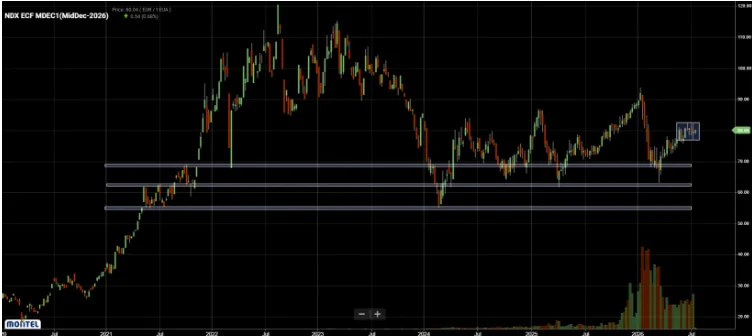
The initial market reaction on the day of the announcement was moderate, with benchmark EU carbon permit prices rising slightly to €79.58/tCO2e. Nevertheless, market analysts anticipate that the easing of the rules will result in structurally lower carbon prices in the future than would have been expected under the previous regime.
Adoption by EU Countries and Next Steps
It is essential to clarify that this proposal has not yet been adopted by EU countries. This marks the beginning of the ordinary legislative procedure.
Agenda and Next Steps:
- Interinstitutional Negotiations: The proposal (procedure 2026/0212/COD) must be debated, amended, and jointly approved by the European Parliament and the Council of the European Union (representing the Member States).
- National Positions: Initial political divergences are already observable. While countries like Poland have welcomed the flexibility for industry, others have expressed reservations about the new conditions for free permits or warn that weakening the system could penalise companies that invested early in emission reductions.
- Transposition: Once the directive is formally adopted and published in the Official Journal, Member States will have until December 31, 2028, to transpose the main provisions into their national legislation, applying them from January 1, 2029 (with some specific measures applicable in 2028 or 2031).
Considerations for Corporate Energy Management
In conclusion, the July 17, 2026 proposal represents a strategic shift by the European Commission: it eases the rigour of the market in the short and medium term to provide industry with the time and capital necessary to undertake a profound technological transition.
For companies exposed to decarbonisation policy, this regulatory environment requires proactive adaptation in their energy procurement and risk management. The new conditionality directly links free allocation to the execution of verifiable decarbonisation plans, making energy efficiency and technological substitution compliance requirements, not just sustainability options. Furthermore, the expectation of a more moderate carbon price path does not eliminate the need for long-term hedging, as industrial electrification will increase demand on power grids. Therefore, companies must align their procurement strategies—such as Power Purchase Agreements (PPAs)—with their technological investment plans, closely monitoring access to new de-risking mechanisms, such as the Carbon Contracts for Difference to be offered by the Industrial Decarbonisation Bank.
If you found it interesting, please share it!
Recent Articles