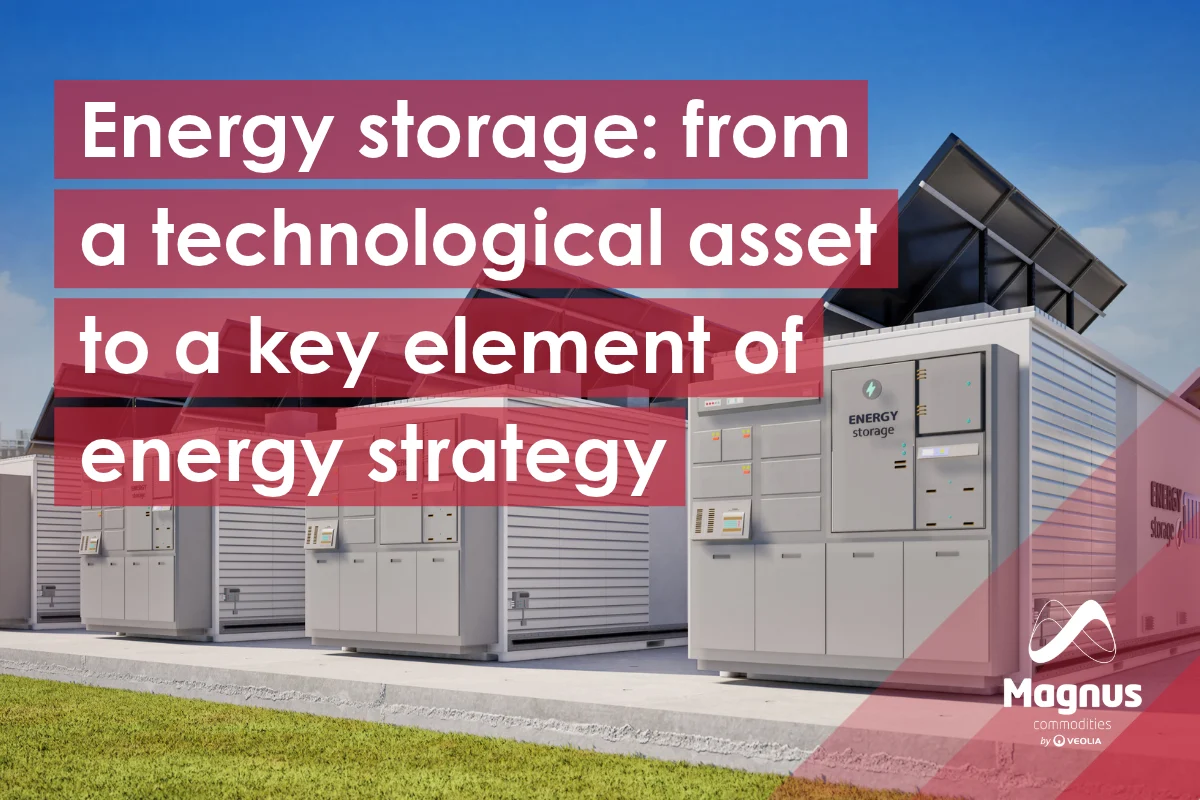
Battery storage is redefining how industry manages energy. Beyond facilitating the integration of renewable generation, a battery energy storage system (BESS) can provide flexibility, economic efficiency and operational continuity. Its value lies not only in the MWh installed, but also in the ability to operate the asset in a way that reflects the site’s consumption profile, tariff structure and market conditions. Flexibility is not limited to electricity: thermal storage can also shift heating and cooling consumption, and both energy streams are best optimised together.
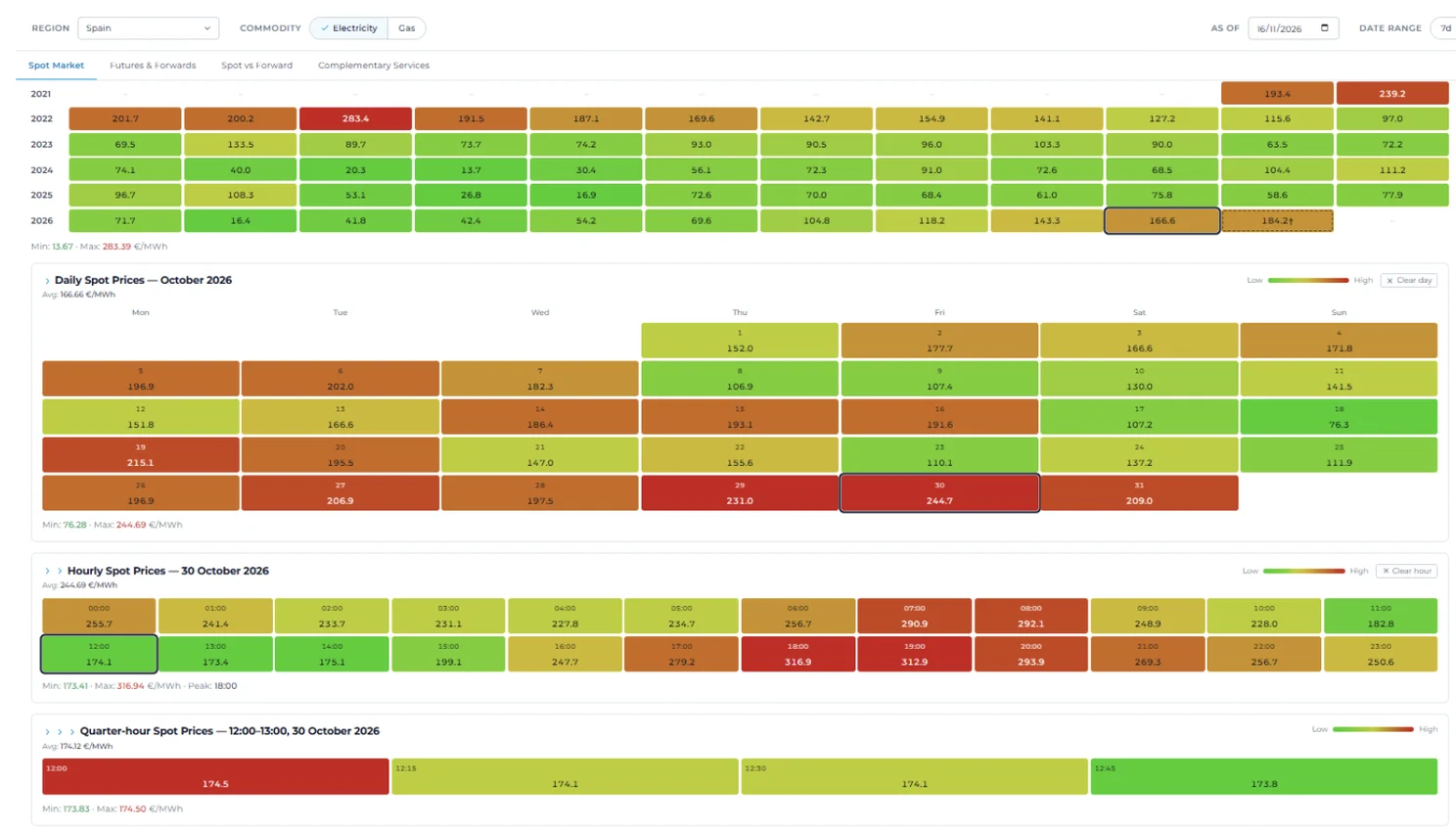 Average Spanish electricity spot market prices (€/MWh): monthly, daily, hourly and 15-minute averages, based on data as of 16 November 2026.
The price of a MWh depends on when it is consumed
The chart above shows average Spanish electricity spot market prices at four levels of detail: monthly, daily, hourly and 15-minute averages. Read from top to bottom, it conveys a simple idea: the value of consuming or producing a MW changes dramatically depending on the time. This price difference is one of the strongest arguments for giving consumers a flexible energy setup, including storage capacity to optimise their resources. For example:
- Monthly average: In 2026, the average price rose from €16.4/MWh in February to €166.6/MWh in October—more than tenfold. Seasonality mainly affects medium-term purchasing strategy.
- Daily average: Within October 2026 alone, the daily price ranged from €76.3/MWh on 18 October to €244.7/MWh on 30 October—a 3.2-fold difference within the same month.
- Hourly average: On 30 October, the price was €173.4/MWh at 13:00 and €316.9/MWh at 18:00, a difference of €143.5/MWh within the same day. The profile reflects the typical pattern of a system with substantial solar generation: lower prices in the middle of the day and peaks in the early morning and at sunset.
- 15-minute average: Between 12:00 and 13:00 on the same day, prices across the four 15-minute periods ranged from €173.8 to €174.5/MWh, a difference of just €0.7/MWh. During stable periods, this granularity adds little, but it becomes valuable during sunrise and sunset ramps and in balancing services, where a rapid response is rewarded.
As an illustration, charging a battery at 13:00 and discharging it at 18:00 on that day yields a gross price spread of around €143/MWh. Even after accounting for cycle losses, assuming a round-trip efficiency of 88–90%, the net margin would exceed €100/MWh before network charges, levies, degradation and operating costs. This was a high-price day and should not be treated as an average, but it illustrates why a consumer with a rigid demand profile continues to pay the price during the most expensive hours, while one able to modulate demand can buy during cheaper hours and avoid the more expensive ones. As long as solar generation continues to grow, it is reasonable to expect this contrast to persist, although its magnitude will vary depending on the year, gas prices and water availability for hydropower.
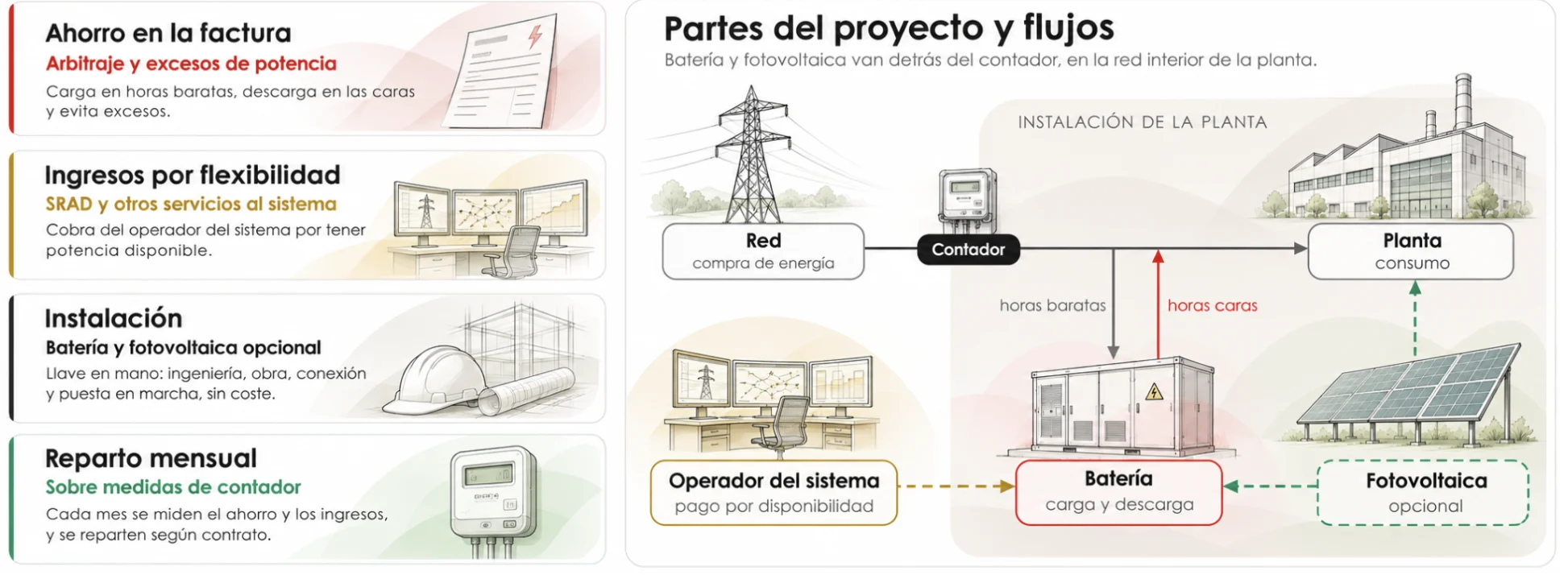
Operation and optimisation of battery energy storage systems (BESS): combining revenue streams and energy savings.
Behind-the-meter BESS: reshaping the consumption profile
A behind-the-meter (BTM) system, installed at the point of consumption, makes it possible to shift energy use over time and modify a facility’s demand profile. This capability opens up several optimisation opportunities that should be assessed together rather than as isolated use cases.
- Energy arbitrage: Charge the battery during lower-cost hours or with surplus self-generated energy, and discharge it when the value of energy is higher.
- Increased self-consumption: Make greater local use of photovoltaic generation by shifting surplus energy to later consumption periods.
- Backup during blackouts or brief grid interruptions: When appropriately configured, batteries can maintain the supply to critical loads during grid outages, minimise production stoppages, protect sensitive equipment against electrical disturbances and improve operational continuity, reducing the risks and costs associated with supply interruptions.
- Contracted-capacity optimisation: Reduce penalties for exceeding contracted capacity through intelligent management of demand peaks—known as peak shaving—using the batteries’ storage capacity to limit power drawn from the grid.
Flexibility and operational resilience
A battery can also contribute to continuity of supply and operational reliability. In configurations designed for this purpose, it can back up critical loads, smooth variations in renewable generation and reduce the facility’s exposure to grid events. These capabilities are not automatic: they depend on the electrical architecture, inverter capacity, control strategy, permits and safety requirements of each site.
A battery can also generate revenue by participating in flexibility markets and services, such as Spain’s Active Demand Response Service (SRAD) and other electricity-system balancing and adjustment mechanisms, provided it meets the technical and qualification requirements. It may also participate in future capacity markets once they are regulated and operational. Order TED/966/2026 of 15 September has approved their creation and provides for the participation of storage, generation and demand-side facilities through auctions that remunerate the availability of firm capacity.
Thermal storage: flexibility for heating and cooling
Flexibility is not limited to batteries. In many industrial plants, a significant share of energy consumption is thermal—hot water, low- and medium-temperature steam, process cooling or refrigeration—and storing heat or cold is often considerably cheaper per kWh than storing electricity. Hot-water or buffer tanks, ice storage systems, phase-change materials, molten salts and the thermal inertia of cold rooms and processes can all help shift electricity consumption to cheaper hours without affecting production.
- Electrification with flexibility: Heat pumps, electric boilers or cooling equipment combined with a storage tank can operate when prices are low or there is surplus photovoltaic generation, supplying heating or cooling when the process needs it.
- Reduced fuel dependency: Stored heat reduces the operating hours of gas boilers, affecting both costs and emissions.
- Participation in flexibility services: A controllable thermal load can offer demand reduction or shifting services to the system, provided it meets the qualification requirements.
Compared with batteries, thermal storage has limitations: it can only meet heating or cooling demand, cannot return electricity to the grid, does not provide backup power during a blackout and loses energy over time. The two technologies are therefore more complementary than competitive: batteries provide speed, power and backup, while thermal storage provides a large volume of energy that can be shifted at low cost. The optimal combination comes from modelling the plant’s electricity and thermal profiles together, along with prices for both energy streams.
Profitability depends on operation, not just size
Sizing a battery solely on the basis of power and capacity can lead to an incomplete assessment. The evaluation should also consider the hourly load profile, the price curve, network costs, degradation, expected cycles, system efficiency, warranty, useful life and potential regulatory constraints. Where relevant, it should also consider compatibility with other sources of value, ensuring that one use does not inefficiently limit another.
There is therefore no universal BESS solution. The optimal design reflects the operational, contractual and energy-related circumstances of each asset.
The aim is to find the right balance between maximising operating revenues and preserving battery life. This requires intelligent management of charge and discharge cycles, taking into account their frequency, depth of discharge and operating conditions to minimise degradation, preserve storage capacity and maximise profitability throughout the system’s useful life.
How we approach it at Magnus Commodities
We start with consumption, production and energy procurement data to identify opportunities for savings, flexibility and resilience. Based on this assessment, we model scenarios, define an operating strategy and help select the technical solution that best aligns with the client’s objectives.
- We integrate storage with self-consumption, energy procurement, PPAs and Guarantees of Origin.
- We assess electrical and thermal storage together, sizing each technology according to the plant’s demand profile and price volatility.
- We evaluate the project from a portfolio perspective: cost, risk, emissions and business continuity.
- We translate technical and market complexity into clear decision-making criteria.
- We design and implement the installation and operate the batteries once installed.
- Magnus Commodities can finance, install and manage the system in exchange for a share of the savings under a 15-year contract—or for the useful life of the batteries. Savings and revenues are shared monthly based on meter readings. The plant does not invest in or operate the installation and assumes no risk.
The challenge is not to install a battery: it is to turn energy flexibility into measurable value for industry.
If you found it interesting, please share it!
Recent Articles